BRRRR stands for Buy, Rehab, Rent, Refinance, Repeat. The idea is simple: buy a below-market property with cash (or short-term money), force value through renovation, rent it, then refinance into a long-term loan and pull your original cash back out — leaving the property to pay for itself while you reuse the same capital on the next deal.
Most explanations stop there, at the slogan level. The strategy does not live in the five steps. It lives in one event in the middle: the refinance. That is where your cash comes back — or doesn't. This guide walks the steps with the refinance math done in full, because that math decides whether "Repeat" happens this year or in five years.
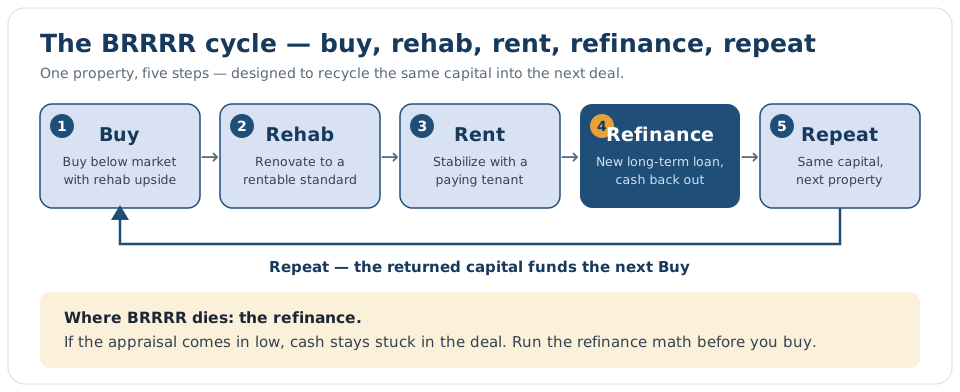
The five steps
1. Buy. The purchase discount is the engine. You are looking for a property that will be worth substantially more than your total cost after renovation. The "after" value (ARV) must come from sold comparable properties — not active listings, not the seller's estimate, not hope.
2. Rehab. Renovate to the standard the appraisal and the rent require, on a budget with a contingency line. Every dollar of overrun is a dollar that has to come back through the refinance, so overruns are not a nuisance — they directly reduce what you recover.
3. Rent. Place a tenant at a verified market rent. The rent is not just income; it is an underwriting input. The refinancing lender will test whether the rent supports the new loan, so a rent that only works on paper fails twice.
4. Refinance. A long-term lender appraises the renovated property and lends a percentage of its value. The proceeds retire your short-term money (or reimburse your cash) minus the refinance's own closing costs. Whatever part of your original investment is not covered stays in the deal — permanently, or until you sell.
5. Repeat. Whatever cash actually came back becomes the next down payment. Note the wording: actually came back. The plan for deal two is written by the appraisal on deal one.
The refinance math
Two formulas run the whole strategy:
Cash left in the deal = Total cash invested − Refinance proceeds (net)
Typical investor refinances land around 70–75% loan-to-value on the appraised value, and many lenders require a seasoning period — commonly 6 to 12 months of ownership — before they will lend on the appraised value rather than your purchase price. Both vary by lender and program. Confirm them before you buy, in writing, because they are the walls of the corridor you are walking into.
Worked example
| Item | Value |
|---|---|
| Purchase price (cash) | $120,000 |
| Rehab | $40,000 |
| Purchase closing + holding costs during rehab | $8,000 |
| Total cash invested | $168,000 |
| Appraised value after rehab (ARV) | $220,000 |
| Refinance at 75% LTV | $165,000 |
| Refinance closing costs | −$4,000 |
| Net proceeds | $161,000 |
| Cash left in the deal | $168,000 − $161,000 = $7,000 |
Yellow = inputs · Green = calculated
This is a good outcome: 96% of the capital comes back, $7,000 stays in a rented property, and the cycle can repeat. But notice how little slack there is — and what the same deal looks like when one input moves.
Where deals die: the appraisal
Same property, same rehab, but the appraiser lands at $200,000 instead of $220,000:
| Item | Value |
|---|---|
| Refinance at 75% LTV | $150,000 |
| Net proceeds after costs | $146,000 |
| Cash left in the deal | $22,000 |
A 9% appraisal miss triples the cash trapped in the deal. You still own a fine rental — but "Repeat" is now delayed by however long it takes to save or recover another $22,000. Deals rarely die at purchase in BRRRR. They die quietly at the appraisal, months after the money is spent.
The second test: can the rent carry the new loan?
Pulling cash out is not the only refinance hurdle. The new loan — $165,000 in the example — costs about $1,098 a month at 7% over 30 years, and the lender will check DSCR: the property's net operating income divided by that debt service. If the rent is too thin, the lender cuts the loan amount, and your recovered cash shrinks again. Run the refinance DSCR before you buy, using the post-rehab rent and the full loan — not after the rehab, when the answer can no longer change your decision. (The ratio itself is covered in our DSCR guide.)
Common mistakes
- Estimating ARV from listings instead of sold comps. The appraisal will use sold properties. So should you, before you spend anything.
- Skipping the contingency line in the rehab budget. Overruns come straight out of your recovered cash, dollar for dollar.
- Assuming the refinance before checking its terms. LTV cap, seasoning period, appraisal basis, DSCR minimum — if you learn these after closing the purchase, you have bought a strategy you may not be able to execute.
- Forgetting the refinance has its own closing costs. Appraisal, origination, title — several thousand dollars that reduce net proceeds.
- Treating "cash left in the deal" as zero by definition. It is a computed number, and in imperfect deals it is often five figures. A BRRRR with $20,000 left in is not a failure — but it is a different plan than the one you announced.
- Having no exit if the refinance fails. Before buying, know what you do if the appraisal comes in low: hold with the short-term money extended, sell, or bring cash to close the gap. Deciding this in advance is what makes it a strategy instead of a bet.
BRRRR checklist
Before the purchase:
- ARV supported by at least three sold comparables, adjusted honestly
- Rehab budget line by line, with a contingency of ~10%
- Rent verified against current listings and leases in the immediate area
- Total cash invested calculated: purchase + rehab + closing + holding
- Refinance terms confirmed with a lender: LTV, seasoning, DSCR minimum, estimated closing costs
- Cash left in the deal computed at the expected ARV — and at an ARV 10% lower
- Refinance DSCR tested at the full post-refi loan amount
- Fallback decided: hold, sell, or bring cash — if the appraisal misses
Run the refinance math before you buy
The free Lite version of the Real Estate Deal Analyzer screens the rental side of any deal — income, expenses, DSCR — on one sheet. The Full version includes a dedicated BRRRR calculator: rehab budget, holding costs, refinance proceeds and the cash left in the deal, so the refinance stops being the step you estimate and becomes the step you computed. Both are on the Real Estate Deal Analyzer page.
The Full version's BRRRR sheet is the refinance math above, as a calculator.
Already sure? Get the Full version:
Buy — PayPal / card ($24) Buy — crypto ($24)Two checkouts, same file: PayPal (card or balance) or crypto (USDT/USDC).
This guide is an educational calculation aid, not financial, tax or legal advice. Lender terms, LTV limits and seasoning requirements vary; confirm them with your lender before purchasing. Verify all figures against local data before making an offer.