NOI is the load-bearing number in rental analysis. Cap rate is built from it, lenders size loans against it, and cash flow starts from it. It is also the number most often inflated — usually by quietly dropping expenses. Here is the exact definition, what goes in, what stays out, and a worked example.
On this page
The formula
Effective gross income (EGI) is scheduled rent minus a vacancy allowance, plus any other income the property produces (parking, laundry, storage fees). Operating expenses are the recurring costs of running the property. That's it — no mortgage, no taxes on your income, no accounting entries.
What counts as an operating expense
- Property taxes
- Insurance (landlord policy)
- Maintenance and repairs — the ongoing kind: leaks, locks, lawn, pest control
- Property management — even if you self-manage. Price your own labor at the market rate (typically 8–10% of rent), or you are comparing a job to an investment
- Utilities the owner pays
- HOA dues, if any
- CapEx reserve — a monthly set-aside for roof, HVAC, appliances and other capital items. Whether to include it in NOI is genuinely debated; lenders often compute NOI without it. We include a separate reserve line (5% of rent in our sample) because the money will be spent either way — but whichever convention you choose, use it consistently across every deal you compare. The reasoning is in our CapEx reserve guide.
What does NOT go into NOI
- Mortgage principal and interest. NOI measures the property unleveraged. Debt is subtracted later to get cash flow.
- Income tax. It depends on your personal situation, not the property.
- Depreciation. A non-cash accounting entry — real for your tax return, irrelevant to operating performance.
- Capital expenditures as lump sums. A new roof is handled through the reserve line, not by dumping $9,000 into one month's expenses.
- Your acquisition costs (closing costs, loan fees). Those belong in "cash invested," not in NOI.
- Amortization of loan points and similar financing items. Financing, again — below the NOI line.
Worked example
A single-family rental at $1,800/month:
| Line | Per year |
|---|---|
| Gross potential rent | $21,600 |
| − Vacancy (5%) | −$1,080 |
| = Effective gross income | $20,520 |
| Operating expenses | |
| Property taxes | $3,000 |
| Insurance | $1,200 |
| Maintenance (5% of rent) | $1,080 |
| Management (8% of rent) | $1,728 |
| CapEx reserve (5% of rent) | $1,080 |
| Total operating expenses | −$8,088 |
| NOI | $12,432 / yr |
Yellow = inputs · Green = calculated
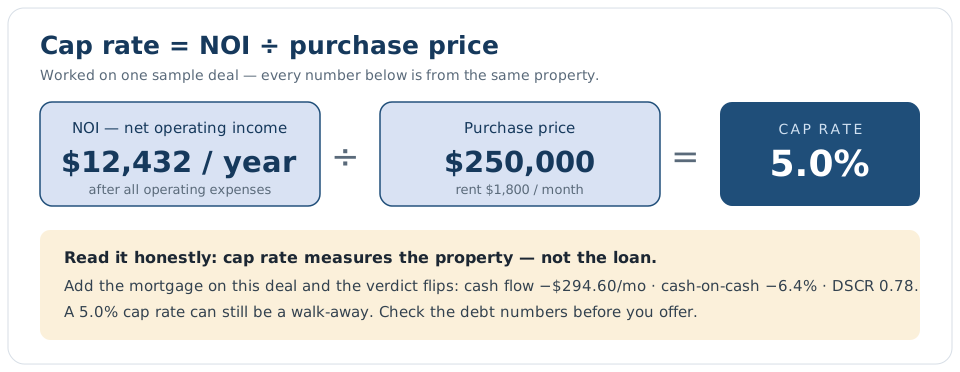
On a $250,000 purchase price, that NOI gives a cap rate of 12,432 ÷ 250,000 ≈ 5.0%. And once a $200,000 loan at 7% (about $15,967/year of principal and interest) enters the picture, this NOI produces a cash flow of −$294.60/month and a DSCR of 0.78. A property can have a perfectly respectable NOI and still fail as a financed investment — which is why NOI is a starting point, not a verdict.
NOI is the numerator of cap rate. Divide the NOI you just built by the price and you have the property's unleveraged return — the full walk-through, with the same example carried into cash flow and DSCR, is in our cap rate guide.
Sanity checks before you trust an NOI
- Compare expense ratios. For many single-family rentals, operating expenses (with management and a CapEx reserve) land around 35–45% of effective income. Far below that range, something is probably missing.
- Verify taxes and insurance from documents, not the listing. Reassessment after a sale can move taxes sharply.
- Ask whose numbers these are. A seller's "actuals" often exclude management and all reserves. Rebuild NOI from your own line items.
Common mistakes
- Including the mortgage payment and calling the result "NOI." That number is cash flow — a different, also useful, metric.
- Excluding management because "I'll do it myself." Then part of your return is wages. Fine — but know it.
- No vacancy allowance. EGI built on 12 perfect months is fiction.
- Treating a one-off repair as an operating expense pattern (or the reverse — spreading a dead water heater into "miscellaneous"). Use the reserve for capital items and actuals for routine ones.
- Mixing conventions between deals — CapEx in one NOI, out of the next — which makes comparisons meaningless.
Calculate it in one pass
Our free Lite analyzer computes EGI, itemized operating expenses, NOI, cap rate and DSCR from the yellow input cells, with the CapEx reserve as its own visible line — nothing hidden. The Full version adds sensitivity analysis, a 5-year projection, BRRRR and deal comparison on top of the same NOI foundation. Details are on the Real Estate Deal Analyzer page.
Lite first, free — NOI built line by line, nothing hidden.
Already sure? Get the Full version:
Buy — PayPal / card ($24) Buy — crypto ($24)Two checkouts, same file: PayPal (card or balance) or crypto (USDT/USDC).
This guide is an educational calculation aid, not financial, tax, or legal advice. Verify all figures against local data and consult licensed professionals before purchasing any property.